
Non-surgical lifting treatments have become one of the most requested categories in skincare, and two options come up more than any other: buccal massage and microcurrent facials. They're often talked about as if they compete. In practice, they work through different mechanisms entirely. As a skin care specialist in Nanuet, NY, here's how each one actually works, and how to tell which fits your face.
"Neither of these is a substitute for surgery or fillers, and we're upfront about that. What they offer is a non-invasive way to support muscle tone and circulation, with results that build through consistency," says Mirela Lupachov, founder and Licensed & Master Esthetician at Rose Ela Skin Care.
What Buccal Massage Actually Does
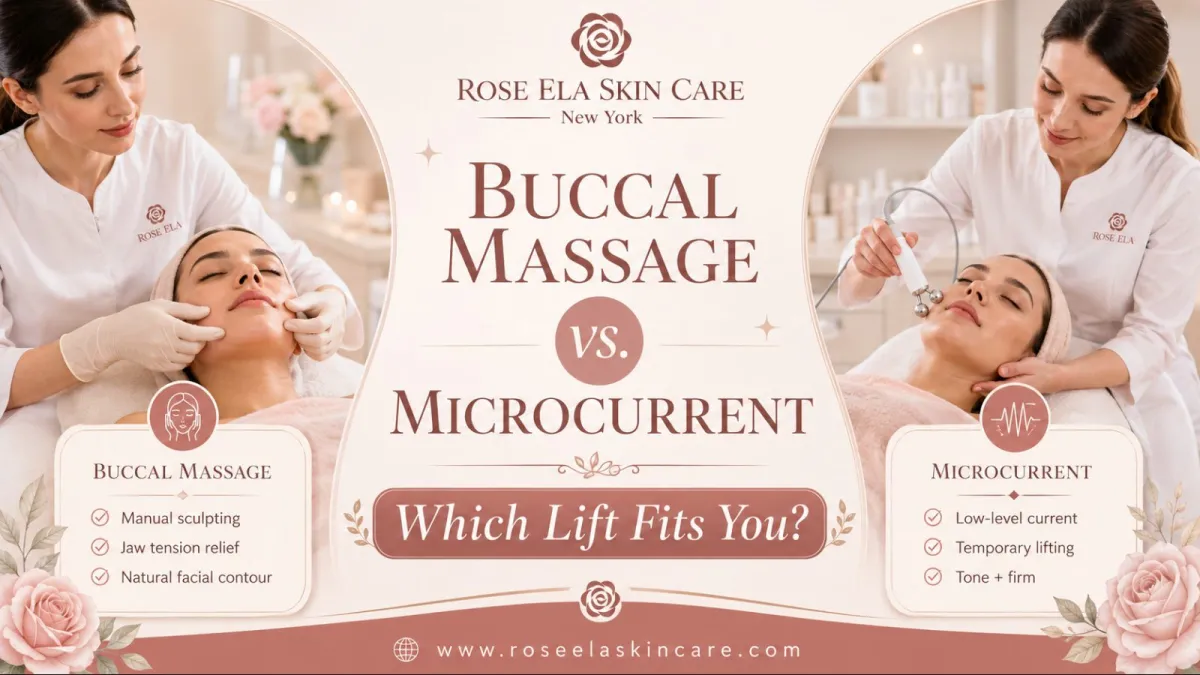
Buccal massage is a manual, hands-on technique. It works both outside and inside the mouth.
How it works: your esthetician massages the muscles of the cheeks and jaw externally, and intraorally, from inside the mouth.
What it targets: facial muscle tension, contour, and circulation.
What it feels like: a firm, hands-on massage, including internal work most facials don't include.
Non-injectable and non-invasive: no needles, no downtime.
Results require maintenance. Buccal massage is not a replacement for surgery or fillers, and its visible lifting effect is temporary, similar to how a workout's effects fade without continued training.
What Microcurrent Facial (with Gua Sha & Cupping) Actually Does
Microcurrent works through a different mechanism entirely: low-level electrical stimulation, paired with manual tools.
How it works: a device delivers gentle microcurrent to stimulate facial muscles, often combined with Gua Sha and cupping tools.
What it targets: facial muscle tone, circulation, lymphatic drainage, and puffiness.
What it feels like: gentle and non-invasive, with no intraoral component.
Backed by early research: a randomized controlled trial published in a peer-reviewed medical library found that Gua Sha massage increased local microcirculation by up to 400%, with effects lasting over 25 minutes post-treatment.
As with buccal massage, results are not permanent. Consistent sessions are what sustain the appearance of tone and lift.
Buccal Massage vs. Microcurrent: Key Differences
Mechanism: Buccal massage uses manual pressure, inside and outside the mouth. Microcurrent uses low-level electrical stimulation plus manual tools.
Access: Buccal massage reaches muscle layers an external-only treatment can't. Microcurrent works entirely from outside the skin.
Sensation: Buccal massage is a firmer, more hands-on experience. Microcurrent facials tends to feel gentler and more spa-like.
Primary focus: Buccal massage emphasizes muscle tension release and contour. Microcurrent leans more toward tone, circulation, and puffiness reduction.
Maintenance: both require ongoing sessions. Neither produces a permanent change on its own.
Which One Might Fit You Better?
Are you dealing with jaw tension or clenching? Buccal massage's intraoral access is built for exactly this kind of tension.
Is puffiness or sluggish circulation your main concern? Microcurrent with Gua Sha and cupping is more focused on drainage and tone.
How do you feel about intraoral work? Buccal massage involves the inside of the mouth, which isn't for everyone. Microcurrent stays entirely external.
Do you want a firmer or gentler session? Buccal massage is more hands-on. Microcurrent is generally the gentler, more relaxing option.
What to Expect at Your First Session
Both treatments typically begin the same way, with a conversation and a facial assessment, before the techniques diverge:
Buccal massage: your esthetician checks in about jaw tension, clenching, and comfort with intraoral work, then combines external massage with gloved, intraoral technique on the cheeks and jaw.
Microcurrent facial: your esthetician maps out areas of puffiness or reduced tone, then uses a microcurrent device alongside Gua Sha and cupping tools across the face and neck.
Neither treatment requires downtime. Some clients notice mild, temporary tenderness in the jaw after buccal massage, similar to how muscles can feel after a workout.
Can You Combine Both?
Often, yes. Because the two treatments work through different mechanisms, they can complement each other rather than compete. Buccal massage can address deeper muscle tension, while microcurrent sessions help maintain tone and circulation between more intensive visits. Whether combining both makes sense for you depends on a skin and facial assessment, not a general rule.
What These Treatments Don't Do
It's worth being direct about the limits here:
Neither is a replacement for a surgical facelift or injectable fillers.
Results are not permanent and depend on ongoing sessions.
Individual results vary based on skin condition, muscle tone, and consistency of visits.
Frequently Asked Questions
How long do results from buccal massage or microcurrent last?
Both are temporary and build with consistency. Many clients maintain results with regular sessions rather than a one-time visit.Is buccal massage uncomfortable because of the intraoral work?
Most clients describe it as firm but tolerable, closer to a deep tissue massage than anything painful. Your esthetician can adjust pressure throughout.How often should I get microcurrent treatments?
Frequency depends on your goals and how your skin responds. A personalized skin analysis helps determine the right schedule for you.Can these treatments replace a facelift or dermal filler?
No. Both are non-surgical, non-injectable options that support muscle tone and circulation. They are not equivalent to surgical or injectable procedures.What if I'm not sure which one my skin needs?
That's exactly what a facial assessment is for. Your esthetician can evaluate muscle tension, circulation, and tone before recommending buccal massage, microcurrent, or a combination of both.Book With a Skin Care Specialist in Nanuet, NY
Buccal massage and microcurrent aren't competing treatments so much as different tools for different goals. Rose Ela Skin Care in Nanuet, NY builds every treatment plan around a personalized skin and facial assessment, so you know which approach, or which combination, actually fits what your face needs.